

💡Your next smart move starts here — learn about  Imolott Hotels View Opportunity
  • OPUM

  • Overview
  • Disclaimer
  • Investment
  • Risk Factors
  • Documents
Click to view pitch deck

Investment Summary


OPUM Technologies
Reinventing Recovery: A Digital Platform for Musculoskeletal Health

Overview:
OPUM Technologies is transforming musculoskeletal rehabilitation by integrating patented wearable sensors, real-time data, and AI-driven insights into a seamless digital health platform.

OPUM is a US-based digital health company leveraging its patented "Digital Knee®" sensor, a HIPAA-compliant patient monitoring ecosystem, and AI-enabled clinician tools to modernize orthopedic recovery.

This intelligent RTM-enabled platform streamlines rehab, verifies compliance for insurers, and empowers patients—unlocking scalable efficiency for clinics and payers.

OPUM aims to become the "Fitbit of Joint Recovery"—delivering real-world outcomes and reimbursement validation at population scale. Investors participate through a common equity raise designed to offer equity upside in a $4B+ addressable market.

This offering is ideal for investors seeking exposure to digital health, value-based care, and medical device innovation—without the timeline risks of biotech or pharma.


Why This Equity Round?

A Hybrid Structure with Proven Technology and Market Fit

Key features of this offering include:
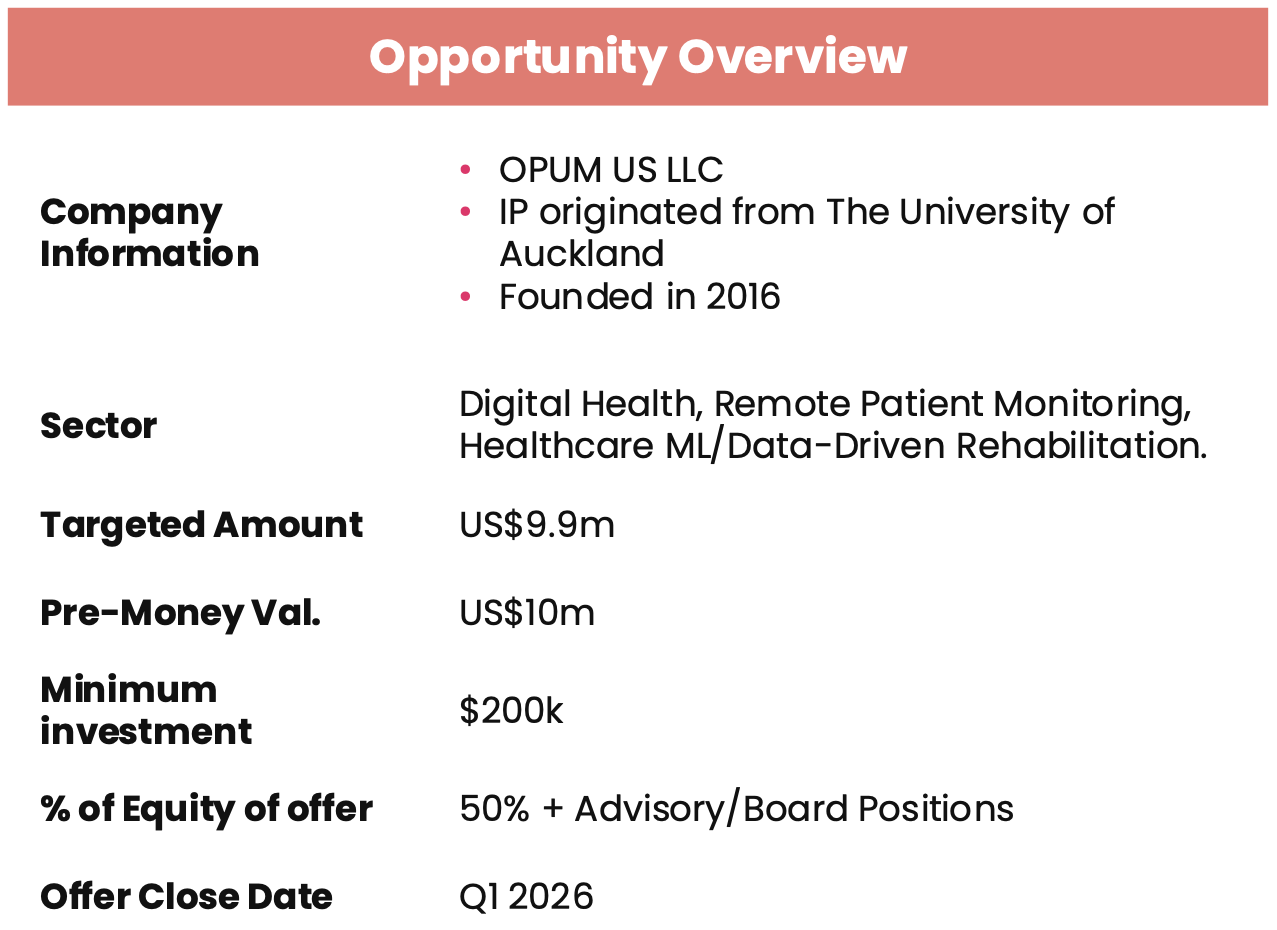
$10M Pre-Money Valuation, $9.9M Raise, 50% Equity Offered
Poised for rapid value appreciation based on clinical traction, IP position, and payer demand.

Patented Digital Health IP
Exclusive technology developed at the University of Auckland—addressing both patient outcomes and insurer requirements.

SaaS-Enabled Recurring Revenue
Monthly reimbursement revenue above 80%.

Validated Market Demand
Pilot programs, payer interest, and FDA cleared technology position OPUM for accelerated rollout.


Why Musculoskeletal Health?

“The Ultimate Value-Based Health Market”

• 1 in 4 adults in the U.S. suffer from joint issues
• ACL, TKA, and OA cases exceed 2.9M annually—$1B+ addressable market for knee conditions alone
• Rehab adherence is <50%—wasting surgeries, slowing healing, and frustrating payers

Driven by:
• Increasing volume of surgeries (ACL/TKA projected to double by 2030)
• Stricter insurance reimbursement criteria (Medicare now requires documented pre-surgery rehab)
• Push toward remote care and digital patient engagement
• High cost of re-injury and revision surgeries

Access has historically been fragmented and analog—until now.


Platform Strategy: Diversification Across Joint Care

Capital from this round will support a revenue-diverse strategy:
Smart Braces (OPUM Stock): Turnkey rehab tech with embedded sensor for clinic-scale deployment
Custom Solutions (OPUM Custom): Sensor retrofit for surgeons/PTs using third-party braces
Remote Monitoring SaaS: Monthly per-patient RTM reimbursements with full clinician oversight
Data Monetization: Aggregated biomechanical insights for payers and insurance validation
Expansion into Other Joints: Hips, shoulders, elbows, and wrists


Proven Leadership: A Team Built for Execution

David Smith, CEO: Founded and sold Tenaxis Medical for $168M
James Henderson, Chair: 30+ years in capital markets, healthcare leadership
Alexandra Wilson, VP Finance & Administration: Scaled consumer brands and guided OPUM through receivership to commercialization
Daniel Willis & Edward Chen, Software Leads: Built and scaled OPUM’s HIPAA-grade platform
Cody Wilson, Product Manager: Ex-Smith+Nephew and founder of AI health tech platform TrialIQ

We don’t just have product-market fit—we have operational firepower to scale.


Investment Structure: Designed for Growth and Exit

Feature Investor Benefit
$10M Pre-Money Valuation Entry at compelling discount to market size
50% Equity Offered Significant ownership in a growth-stage firm
Target Raise: $9.9M Funds 24-month runway to EBITDA+
Revenue by 2028: $41.4M               Driven by high-margin products + SaaS
Exit Timeline: 3-5 Years IPO or strategic acquisition pathway
IP Ownership: 100% Exclusive patents from Univ. of Auckland

Conclusion: The Future of Recovery Is Here

OPUM Technologies’ common equity isn’t just an investment—it’s a stake in the future of orthopedic care.

By combining hardware, software, and SaaS in one seamless platform, we give investors access to:
• A $1B+ wedge in the $4B joint rehab market
• A patented platform built for RTM reimbursement and clinical compliance
• A management team with exits and operational track records
• A vision that expands across joints, data monetization, and sports medicine

OPUM is where better care meets better outcomes—and scalable revenue.


Financial Highlights


Disclaimer:

All documents included in the listing are prepared and provided by the company and not endorsed by Regiment Securities.

This document has been prepared by the Issuer on a confidential basis for selected institutional, qualified, and accredited investors for the sole purpose of providing, on a non-reliance basis, preliminary information about the Issuer, its affiliates, and a prospective investment offering.

This document is strictly confidential and should not be distributed, published, or reproduced, in whole or in part, nor should its contents be disclosed by recipients to any other person. Each recipient of this document shall be responsible for any unauthorized disclosure of this document, or any information contained herein, by any of its employees, agents, or representatives. This document may, however, be disclosed, on a non-reliance basis, to legal, tax and other advisers to the extent necessary to evaluate the offering and equivalent terms bind the recipient to confidentiality. If you are not the intended recipient of this document, you are hereby notified that the use, circulation, quoting, or reproducing of this report is strictly prohibited and may be unlawful.

This document has been prepared to provide background information only. This document does not constitute an offer or invitation to subscribe or purchase any securities. An invitation to invest will only be made on the distribution of final offering documents. A full description of the investment terms and related risk factors of the offering will be outlined in the offering documents. Private alternative investments are inherently risky and may only be suitable for certain investors. Parties should independently investigate any potential investment and should consult with qualified investment, legal and tax professionals before making any investment.
Past performance is not indicative of future results, or results expected to be realized by any investment. There can be no assurance that any investment will have a return on capital similar to any historical performance or future projections.

The information contained herein is only current as of the date indicated and may be superseded by subsequent market events or for other reasons. These materials may include historical market data and financial statements, however, historical market trends are not reliable indicators of future market behavior. Any statements of opinion constitute only current opinions of the Issuer, which are subject to change and which the Issuer does not undertake to update.

The securities described herein are not registered under the Securities Act of 1933, as amended, or the securities laws of any state and are being offered and sold in reliance on exemptions from the registration requirements of said Act and legislation. Neither the offering’s legal documents nor the offering have been reviewed or approved by U.S. federal or state regulators.

Investment in a private offering is speculative and involves other and special risks, and there can be no assurance that any offering’s investment objectives will be realized. An investor could lose all or a substantial portion of his or her investment and successfully overcoming barriers to entry, e.g., legal, and regulatory enterprise does not guarantee successful investment performance. The securities should be considered illiquid as there are significant restrictions on transference. There are no secondary markets for the securities, and none are expected to develop.

Investors must have the financial ability, sophistication/experience, and willingness to bear the risks of investment in the offering. Investment in any offering should be discretionary capital set aside strictly for speculative purposes. A private placement is not subject to the same regulatory oversight and regulatory requirements as a registered offering. The Issuer is not required to provide periodic pricing or valuation information to investors. Investments may involve complex tax structures resulting in delays in distributing important tax information. There is no secondary market for an investor’s interest in a private offering. The aforementioned is not an inclusive list of all risk factors, and investments in private offerings may only be suitable for certain investors. A comprehensive list of potential risk factors may be found in the Issuer’s above referenced offering documents.
These materials may contain forward?looking statements based on experience and expectations of the Issuer. Those forward?looking statements are not guarantees of future performance and are subject to many risks, uncertainties and assumptions that are difficult to predict. Therefore, the actual returns could be much lower than those expressed or implied in any forward?looking statements as a result of various factors. Neither the Issuer nor any of its affiliates nor any other entity has any obligation to revise or update these materials or any forward?looking statements set forth herein. The information in the attached materials reflects the general intentions of the Issuer. There can be no assurance that these plans will not change or be adjusted to reflect the environment in which the Issuer will operate.

Marketing Representative/Selling Agent: Regiment Securities, LLC (“RSLLC”), is a registered broker-dealer, Member FINRA/SIPC. RSLLC has been retained to act as introducing agents for the offering. RSLLC and certain of their personnel will be entitled to receive compensation related to investments made to the offering (as applicable). Although RSLLC may provide summary information regarding the offering, it is not providing “due diligence” on an investor’s behalf and is not responsible for an investor’s investment decisions. The information contained herein has been supplied by , and no representation or warranty is made by at as to the accuracy, timeliness, or completeness of such information

PLACEMENT AGENT DISCLOSURE: This Disclosure Statement is being provided to you to describe the relationship between OPUM US Holding Company Inc (“Company”) and Regiment Securities, LLC (“Regiment”), relating to your investment in the Company. Regiment is a registered broker-dealer member of FINRA and SIPC. The Company and Regiment are not related parties. The Company and Regiment have entered into an Engagement Letter Agreement (“Agreement”) under which Regiment provides investment banking advisory services and solicits investor prospects for the Company, and the Company compensates Regiment for referring investors to the Company.

For each person or entity (including “You,” the “Investor”) that is solicited by Regiment pursuant to the terms and conditions of the Agreement, who acquires or commits to acquire an interest in the Company within a defined time period as a result of such solicitation, the Company shall pay, or cause to be paid, to Regiment and any licensed Selling Agents it may be working with, the following compensation:

• Seven percent (7.0%) of any debt capital raised for the Company from Introduced Investors, payable when such debt capital is received by the Company. For the avoidance of doubt, debt capital shall include unsecured promissory notes, convertible notes, and other commercial financing instruments.

• Seven percent (7.0%) of any equity capital raised for the Company from Introduced Investors, payable when such equity capital is received by the Company. For the avoidance of doubt, equity capital shall include co-GP investments, joint venture equity investments, and/or common equity investments.

• One percent (1.0%) of any capital raised that was not introduced by Regiment, payable when such capital is received by the Company. For the avoidance of doubt, capital shall include both equity and debt instruments.

No other success-fee-based compensation shall be paid to Regiment.

This compensation to Regiment does not in any way affect the number of securities that would be issued to you if you acquired such interests without the solicitation of Regiment or any of its Selling Agents. These fees may cause a conflict between your interests and Regiment. Registered Representatives of Regiment and their family members may be or may become investors in this transaction or in any other Company issuance. This may also cause a conflict of interest in your investment. Registered Representatives of Regiment and Selling Agents may be engaged to solicit other transactions at higher or lower compensation arrangements, which may also be a conflict of interest relating to your solicitation for this investment. The Firm may also provide you with other comparable investment opportunities that should be considered and discussed with your representative prior to making any investment.

Initial payment, due diligence fees, and retainer amounts under the Agreement have been waived.

Project Title Document Title Action
OPUM PPM View
OPUM Investor Deck View
OPUM Executive Summary View
OPUM History View
Profile picture of

RISK FACTORS

I. Business Risks

• This Company is dependent upon the continued contributions to the Company by certain Key Personnel. The loss of such individuals could seriously impact our ability to both maintain existing operations and pursue new initiatives. Key risks related to our industry include, without limitation, the following.
• The Company initiated efforts to develop its products, but has not yet optimized them, nor does the Company have a fully-funded marketing effort; competitive offerings may make it more difficult than management anticipates in order to meet future-looking financial results.
• OPUM is an early-stage commercial company operating in a new category of smart orthopedic rehabilitation, and our success is uncertain.
• OPUM US Inc. has only recently begun commercializing its Digital Knee® platform in the United States; while the Group has several years of research and pilot experience, our products are still in the early stages of adoption, and we have limited operating history as a revenue-generating business; there is no assurance that the market will accept our smart-brace and SaaS-based rehabilitation solutions or that we will achieve commercial success; we expect to incur operating losses as we continue to fund sales expansion, clinical validation, and product development.
• Clinical-Validation Risk: Market adoption depends in part on compelling clinical evidence supporting the Digital Knee® platform; delays in IRB approvals, insufficient study enrollment, unfavorable results, or failure to complete clinical trials could reduce payer acceptance, hinder provider adoption, and negatively impact commercialization.
• Dependence on a Single Commercial Product: OPUM currently depends almost entirely on the Digital Knee® platform for commercial revenue; any delay, quality issue, regulatory challenge, or market resistance involving this single product would materially affect the Company’s performance; OPUM may not successfully develop additional products or diversify revenues in the near term.
• OPUM may require substantial additional capital to fund operations and growth and may not be able to raise it on acceptable terms; inability to obtain adequate financing may require delays or scale-backs in commercial launches, R&D programs, or expansion plans; future equity financing may dilute shareholders and debt financing may impose restrictive covenants.
• Intercompany IP-Ownership and Foreign-Jurisdiction Enforcement Risk: All core patents are held by OPUM Technologies Innovations Ltd., a New Zealand subsidiary, and licensed to OPUM US Inc.; enforcement of these patents in U.S. courts may be limited by foreign-jurisdiction issues, transfer-pricing scrutiny, or licensing changes.
• Market adoption of smart-brace technology is not guaranteed; surgeons and PT clinics may hesitate to change workflows or invest in digital tools; failure of providers or payers to recognize clinical or economic benefits may harm revenue.
• Clinician Adoption and Workflow-Change Risk: Commercialization depends on orthopedic surgeons, physical therapists, and clinic staff incorporating the technology into workflows; providers may resist change, prefer incumbents, or decline to use digital systems; slow adoption could materially affect growth.
• Reimbursement frameworks may change or fail to support the offering; changes in coding rules, reimbursement rates, or payer policies could materially impact usage and revenue.
• Volatility in RTM/RPM Reimbursement Codes: CMS may reduce rates, narrow eligibility, or eliminate RTM billing categories, lowering clinician incentives.
• Customer-Concentration Risk: Early revenue is expected to be concentrated among a limited number of orthopedic clinics and PT networks; loss of any major customer could materially impact revenue.
• Competition from established brace manufacturers, digital-rehabilitation companies, or emerging smart-brace start-ups may limit growth; OPUM may not have resources to compete successfully with larger or better-funded companies.
• Emerging AI-Rehabilitation Competitors: AI-driven digital-rehabilitation platforms may reduce OPUM’s competitive advantage.
• OPUM depends on successful collaboration between the U.S. commercial arm and New Zealand subsidiaries; disruptions in supply chains, engineering support, logistics, or governance could delay delivery and increase costs.
• Foreign-Currency Exchange Risk: R&D, engineering, and manufacturing in New Zealand expose OPUM to NZD/USD fluctuations.
• Cross-Border Tax and Transfer-Pricing Risk: Intercompany arrangements may be subject to audits, withholding obligations, and repatriation restrictions.
• IP Risks: The cost and difficulty of generating, protecting, and defending intellectual property may be substantial; competitors may bring infringement claims that are costly to defend and unpredictable in outcome.
• Trade-Secret Risk: Reliance on confidentiality agreements may not sufficiently protect trade secrets, especially across jurisdictions.
• Failure to Realize Targets: Failure to deliver on the business plan may negatively affect cash flow, impair financing ability, and reduce operational capability.
• Key Personnel Risk: Loss of key executives or technical staff could delay development and hurt customer/investor relationships.
• Scaling Manufacturing and Supply Chain: Component shortages, QC failures, regulatory issues, shipping delays, and geopolitical restrictions may impair manufacturing; certain critical components have long lead times and no substitutes.
• Counterfeiting and Offshore-Production Risk: Offshore manufacturing increases risk of unauthorized duplication or counterfeit products harming safety and brand.
• Tariff and Trade-Regulation Risk: New tariffs, duties, or import regulations may increase cost of goods and reduce competitiveness.
• Multi-Jurisdiction Regulatory Compliance Risk: Failure to maintain FDA registration or other certifications may result in enforcement actions or costly modifications.
• Cyber-Security and System-Outage Risk: Breach or outage of the SaaS platform could lead to penalties, litigation, reputational harm, and customer loss.
• Third-Party Logistics and Vendor Risk: Failures of external vendors or partners may disrupt product delivery or reimbursement support.
• Pricing Pressure and Margin Compression: BOM cost increases or reimbursement-linked pricing constraints may harm margins.
• Supplier Termination and Component Lifecycle Risk: Discontinued components or supplier termination may require costly redesigns.
• Hardware, Firmware, and Recall Risk: Defects or malfunctions could trigger recalls, reputational damage, and regulatory expense.
• SaaS Reliability and Cloud-Vendor Dependency: Cloud outages or disruptions may impair clinician workflows and customer trust.
• Cyber-Insurance Coverage Risk: Coverage limits may be insufficient and premiums may rise.
• Regulatory Reclassification and Policy-Change Risk: New FDA standards or classification changes may create costly delays.
• Limited Operating History: OPUM has a short operating history with recurring losses and expects continued losses; no assurance exists regarding profitability or product commercialization.
• Going-Concern and Recurring-Losses Risk: Additional capital is required to continue operations; lack of funding may force the Company to curtail or cease business.
• Shareholder Loan Priority and Liquidity Risk: Approximately $2MM in shareholder loans may have priority in liquidation and pressure liquidity.
• Financial Uncertainty: Even $9.9MM in gross proceeds provides only limited runway; additional capital will likely be required.
• Future Capital Requirements May Be Substantial: Progress, partnerships, regulatory approval, patent costs, and commercialization needs will drive future capital requirements and potential dilution.
• Need for External Partnerships: Success may depend on collaborations with brace companies, insurers, clinicians, and others; failure of partners to perform or termination of arrangements may harm development or commercialization.
• Third-Party Reimbursement Need: OPUM’s revenue may depend on payer reimbursement; lack of reimbursement could reduce valuation and profitability.
• Product-Liability Exposure: Product failure may expose OPUM to liability exceeding insurance coverage.
• Founder/Management Control Risk: Founders and executives hold a majority of voting stock and may exert substantial control over corporate decisions.
• Conflicts of Interest: Board and executives may have external commitments that create conflicts or reduce focus on OPUM.


II. Risks Associated with The Offering

• Accredited Investor Verification Risk: Investors must provide documentation to verify Accredited Investor status under Rule 506(c); insufficient documentation may result in rejection.
• Offering Price Risk: The offering price is set by OPUM and may not reflect market value; future financings may occur at lower valuations.
• No Distributions: OPUM does not anticipate making distributions.
• Dilution Risk: Investors will experience immediate and significant dilution; future rounds may cause further dilution.
• Equity Incentive Dilution and Option-Pool Expansion: Future equity awards may dilute investors.
• Lack of Liquidity: No ready market exists for shares; transferability is restricted; investment should be viewed as long-term.
• Availability and Timing of Future Financing: Future capital needs depend on development, collaborations, regulatory approvals, patents, and commercialization.
• Discretion Over Use of Proceeds: The Company may redirect proceeds at its discretion.
• Tax Ramifications: OPUM is a C-corp; investors should consult tax advisors.
• Corporate Tax Risks and NOL Limitations: NOL usage may be restricted by tax rules, increasing future tax burdens.

Sign up to invest Schedule a call

Investment Summary

  • Deal Type : Healthcare Technology
  • Issuer : OPUM US Holding Company Inc
  • Funding Goal : $9.9M
  • Min. Investment : $200,000
  • Investment Vehicle : Reg D 506c

  • peter.apostol@regimentsecurities.com

Documents

Contact Investor Relations Image
Peter Apostol

Registered Representative
Regiment Securities